
Insight; Craft as Low-Carbon Practice
Craft as a Low‑Carbon Practice: Building Lightly, Building Beautifully
If craft is the heart of our work, low‑carbon thinking is its lifeblood. These two ideas – beauty and carbon – might seem separate, but in practice they are intimately intertwined.
Craft encourages us to build with fewer, better materials. It pushes us towards natural, local and low‑embodied‑carbon systems: timber, clay, flint, stone, brick, hemp, lime. These are ancient materials, with histories reaching back long before our modern climate vocabulary, and yet they align perfectly with contemporary environmental responsibility.
Natural materials store carbon. They age gracefully. They resist trends. They invite repair. They minimise waste. They inspire care. Their beauty is part of their sustainability.
Our Paragraph 84e house on the Isle of Wight, currently on the drawing board project, an earth‑sheltered home shaped from gabions filled with local Purbeck stone and a timber superstructure, embraces this principle profoundly. It avoids the concrete mass typical of underground buildings, replacing it with carefully modelled natural systems and a crafted interface between gabion and timber. It is a building that grows from the land itself, rather than being imposed upon it.

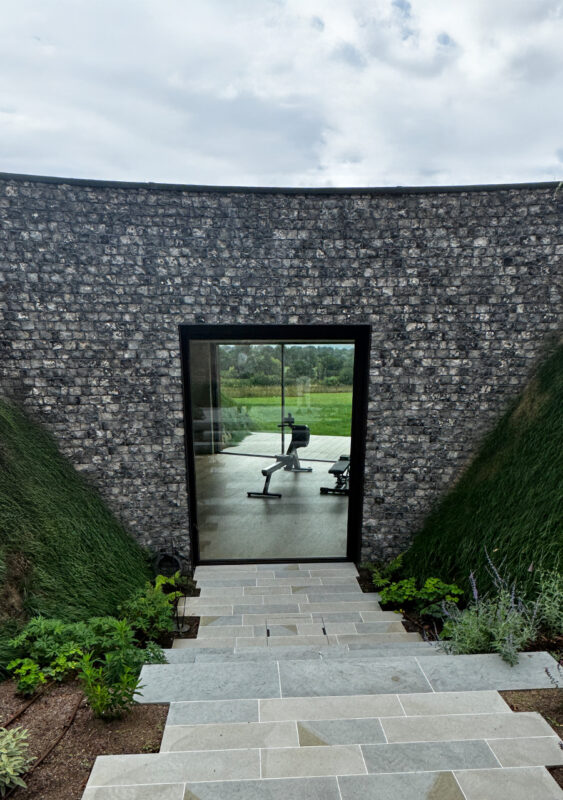

The Retreat at Sussex House similarly explores the sweet spot where low-carbon ambition and craft meet. It pairs a slender, experimental earth‑sheltered shell with handmade knapped flint and a curved bespoke glazing system – a marriage that required creative structural thinking, close collaboration with makers, and a deep respect for material behaviour, both new and old.
At Chestnut Farm, the lightweight chestnut‑clad home touches the ground lightly, following the woodland slope while minimising permanence. Prefabricated modules, transported to site and resting on removable piles, demonstrate that low‑carbon design can be crafted, warm and intimately connected to place.
At Lane End, highly insulated timber construction supports a modest footprint and a generous way of living. The shingle cladding, limed Douglas fir interiors, and crafted daybed nook embody both environmental and emotional sustainability.
Craft matters especially in retrofits – a theme we intend to explore more deeply in future Insights. At Friars Lodge, The Keepers Lodge, and The Water Tower, the sensitive reuse of historic fabric is itself a low‑carbon act. Restoring brick, retaining timber, refreshing stone, fitting high‑performance windows into historic fabric – all of this requires a craft mindset. Retrofits are among the most challenging design contexts, because every junction and layer must respect both breathability and heritage. But they also offer enormous opportunity: to preserve the embodied carbon of the past while giving buildings new life.
At Warborne Farm, historic agricultural barns are transformed into light-filled dwellings using sheep’s wool, reclaimed timber, and renewable energy systems, demonstrating how traditional craft can coexist happily with contemporary performance.
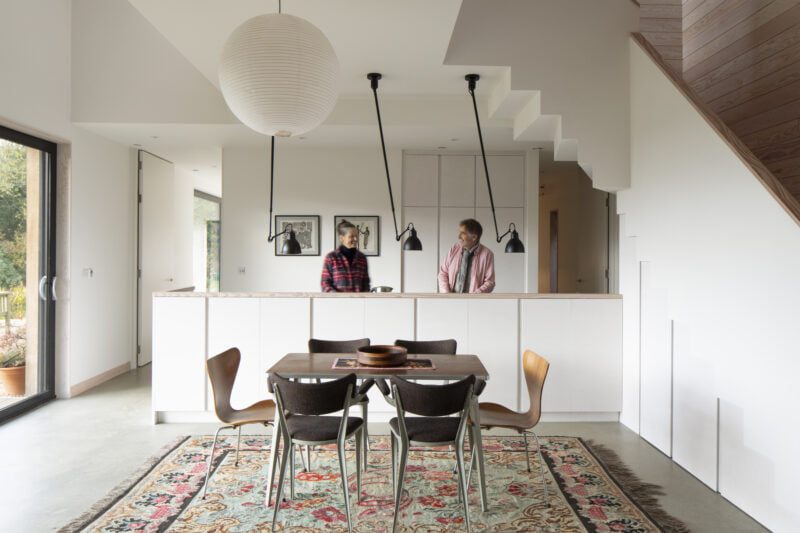


Craft, then, is our bridge between the past and a regenerative future. It teaches us to build slowly, to value skill, to understand materials deeply, to make decisions that last. It pushes us away from high-energy, short‑lived systems and towards buildings that are rooted, resilient and loved.
In this second part of our reflection, we celebrate craft not as ornament or luxury, but as a profound low‑carbon strategy.
Because beauty and sustainability are not opposites: They are partners, and when we embrace the hand of the maker – the trace left across time – we build in a way that honours both people and planet.